 +91-9810222486
 contact@thebanyanworld.com

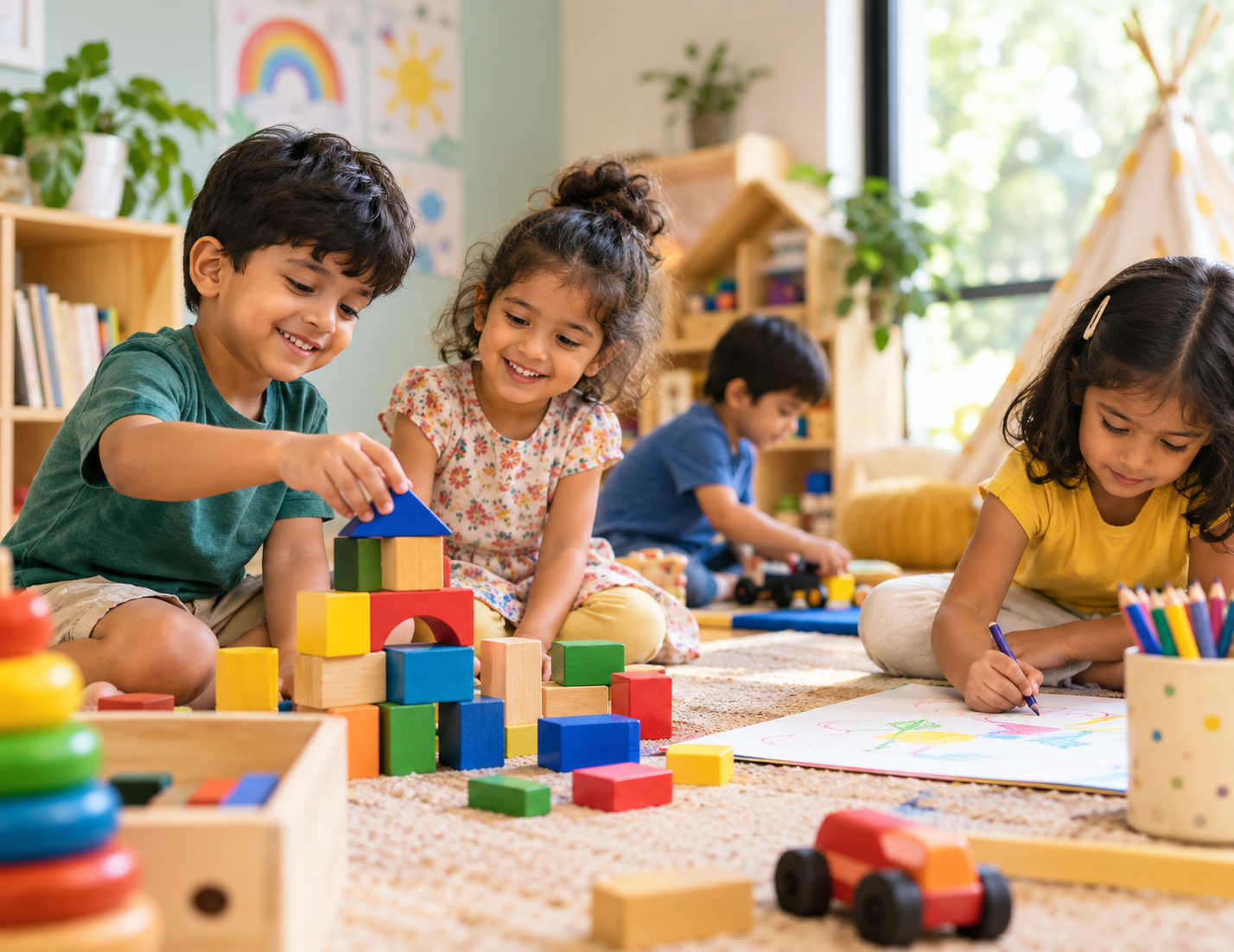
The Hidden Learning That Happens During Play
Why Playtime Is More Important Than Ever
Many parents still think learning only happens when children sit with books, worksheets, or structured lessons.
But early childhood experts continue to emphasize one important truth:
Children learn best through play.
Play is not "extra time."
Play is development.
When children play, they are building skills that cannot always be taught directly.
What Is Play Based Learning?
Play based learning is an approach to early childhood education where children learn through exploration, imagination, and hands-on experience instead of memorising facts. In a play based preschool, educators set up activities and environments that invite children to discover ideas on their own, with gentle guidance along the way.
It is sometimes called experiential learning because children learn by doing, touching, trying, and talking.
The Skills Children Build Through Play
Simple activities like blocks, pretend games, storytelling, art, and movement help children develop:
- Problem-solving skills
- Creativity
- Communication
- Emotional regulation
- Confidence
- Social understanding
What Different Types of Play Teach
| Type of play | Example | What children learn |
|---|---|---|
| Block and building play | Stacking blocks, building towers | Problem-solving, spatial thinking, patience |
| Pretend play | Playing house, doctor, shopkeeper | Imagination, empathy, language |
| Art and craft | Drawing, painting, clay | Focus, fine motor skills, self-expression |
| Storytelling and music | Stories, rhymes, songs | Listening, vocabulary, memory |
| Outdoor and movement play | Running, climbing, ball games | Confidence, balance, independence |
| Group games | Taking turns, team activities | Cooperation, communication, social skills |
How Play Supports Every Area of Development
Cognitive development in preschool. Puzzles, sorting, and building games help children think, plan, and solve problems.
Emotional development in preschool. Through pretend play and storytelling, children learn to name feelings, manage frustration, and understand how others feel.
Social skills in preschool. Sharing, waiting for a turn, and playing together teach cooperation and kindness.
Physical development. Running, climbing, and playing with small objects build strong bodies and fine motor control.
Language development. Chatting during play, singing, and storytelling grow vocabulary and communication.
Play Based Learning at Banyan
At Banyan, play-based learning is integrated into everyday experiences.
Children naturally absorb lessons when they feel curious and engaged.
For example:
- Sharing toys teaches cooperation
- Roleplay builds imagination and empathy
- Drawing improves focus and self-expression
- Outdoor play develops confidence and independence
The biggest advantage of play-based learning is that children enjoy the process.
Instead of learning through pressure, they learn through exploration.
Play at Every Age
Children play differently as they grow, and good early childhood learning matches each stage:
- Infants and toddlers (6 months to 2 years): sensory play, exploring textures, sounds, and movement, always with a caring adult close by. At Banyan, our Playnest program is built around this kind of early exploration.
- Ages 2 to 3: simple pretend play, early art, and parallel play beside other children. These are great preschool activities for toddlers.
- Ages 3 to 4: cooperative play, storytelling, building games, and the first group activities.
- Ages 4 to 6: more structured games, role play, early problem-solving challenges, and preparation for formal school, all still through play.
Explore Our Programs for Every Age
Play vs Screen Time
This approach becomes especially important today because children are increasingly exposed to screens and overstimulation at very young ages.
Real-world play helps children stay emotionally connected, physically active, and socially aware.
Screens are passive. Children watch, but they do not touch, move, negotiate, or imagine in the same way. Real play involves other people, real objects, and real feelings, which is why it builds skills that screens cannot.
A simple balance helps: keep screen use limited, and make daily time for hands-on, face-to-face play.
Simple Learning Activities for Toddlers and Preschoolers at Home
You do not need expensive toys. Try these easy activities for preschool children:
- Build together: blocks, boxes, or cups to stack and knock down
- Pretend play: a kitchen, shop, or doctor's clinic using household items
- Sensory bins: rice, water, or sand with spoons and cups, with supervision
- Story time: read aloud, then ask "What do you think happens next?"
- Art corner: crayons, finger paints, and paper for free drawing
- Move and groove: dance, obstacle courses, and simple ball games
- Nature walks: collect leaves and stones, and talk about what you see
How Play Builds Confidence in Children
Parents often ask how to build confidence in children. Play is one of the best ways. When children try, fail, and try again in a safe space, they learn that mistakes are part of learning. Each small success, like finishing a puzzle or making a new friend, adds to their sense of "I can do this."
What to Look for in a Play Based Preschool
If you are choosing a preschool, look for:
- A balance of free play and guided activities
- Educators who join in and ask open-ended questions instead of only giving instructions
- Safe, clean spaces with both indoor and outdoor play areas
- A variety of materials: blocks, art supplies, books, and role-play props
- Happy, engaged children who feel free to explore
- Open communication about what children learned through play each day
The Goal Is More Than School Readiness
The goal is not just preparing children for school.
It is preparing them for life.
And some of the most meaningful lessons begin during the simplest moments of play.
When children play, they are not wasting time. They are learning to think, feel, share, and grow. At Banyan, we believe that giving children the freedom to play is one of the most powerful ways to support their development.
Related reading
- School Ready vs Emotionally Ready: The Conversation Every Parent Is Having
- The New Definition of "Good Schools" According to Modern Parents
Frequently Asked Questions
1. What is play based learning?
Play based learning is a way of teaching young children through exploration, imagination, and hands-on activities instead of memorisation. Children learn skills like problem-solving, communication, and cooperation while they play.
2. Why is play important in early childhood education?
Play helps children build thinking, emotional, social, physical, and language skills at the same time. It also keeps learning enjoyable, which makes children more curious and confident.
3. What is a play based preschool?
A play based preschool uses activities such as blocks, role play, art, storytelling, music, and outdoor games to teach. Educators guide children gently instead of relying on worksheets and pressure.
4. Do children really learn through play?
Yes. Early childhood experts widely recognise that young children learn best through play, because it lets them practise real skills in a natural, low-pressure way.
5. What are good preschool activities for toddlers?
Sensory play, simple building games, rhymes and songs, finger painting, and pretend play all work well. Keep activities short, safe, and supervised.
6. How does play help social and emotional development?
Through play, children practise sharing, taking turns, handling disappointment, and understanding other people's feelings. These are the foundations of emotional and social development in preschool.
7. How much playtime does a preschool child need?
There is no single number, but children need daily time for active, hands-on play, both indoors and outdoors. A good preschool builds play into the whole day.
8. Is play based learning enough to prepare my child for school?
Yes, when done well. Play builds language, early maths ideas, focus, and independence, along with the emotional comfort children need to enjoy learning in formal school.
9. How can I encourage play at home?
Offer simple materials like blocks, paper, and household items, keep screen time limited, and join in. Letting your child lead the play builds creativity and confidence.
10. How do I know if a preschool is truly play based?
Look for children who are busy, curious, and happy, a mix of free play and guided activities, and educators who ask questions and join in rather than only giving instructions.
 Call Us
 Email Us